 Skip to content
At 6:30 a.m., CPS shows up, your child leaves with a stranger, and by that afternoon you are hearing words like "temporary managing conservatorship" and "Adversary Hearing" as if you are supposed to know what any of them mean. In Montgomery County, the part that matters most starts immediately. You have a very short window to get organized before a judge in The Woodlands decides whether CPS had legal grounds to remove your child and whether the agency keeps custody while the case continues.
Do not rely on the idea that being polite and patient will fix this. Those first 14 days decide the tone of the entire case. Local judges are not deciding whether you are a perfect parent. They are deciding a narrower question under Texas removal law: was there an immediate danger to the child, was removal urgent, and is there a safer option than keeping the child out of your home right now. That standard is where parents win or lose early.
If you are in crisis and need a practical overview of how to fight CPS in Montgomery County, focus on what you can prove, not what you hope CPS will "understand." Hope is not a defense. Documents, witnesses, drug test results, medical records, school records, safe-relative options, and a clear explanation of the events are.
This article is for informational purposes only and is not legal advice. Still, you need a straight answer. In a CPS removal hearing in The Woodlands, the first serious court fight is the hearing required by Texas Family Code § 262.201, which follows an involuntary removal and forces CPS to justify what it did. If CPS cannot show immediate danger, urgent need, and the lack of a workable alternative, the judge has a reason to limit the removal, place the child with family, or order the child returned under conditions.
What you do before that hearing matters more than what you say in the hallway outside the courtroom.
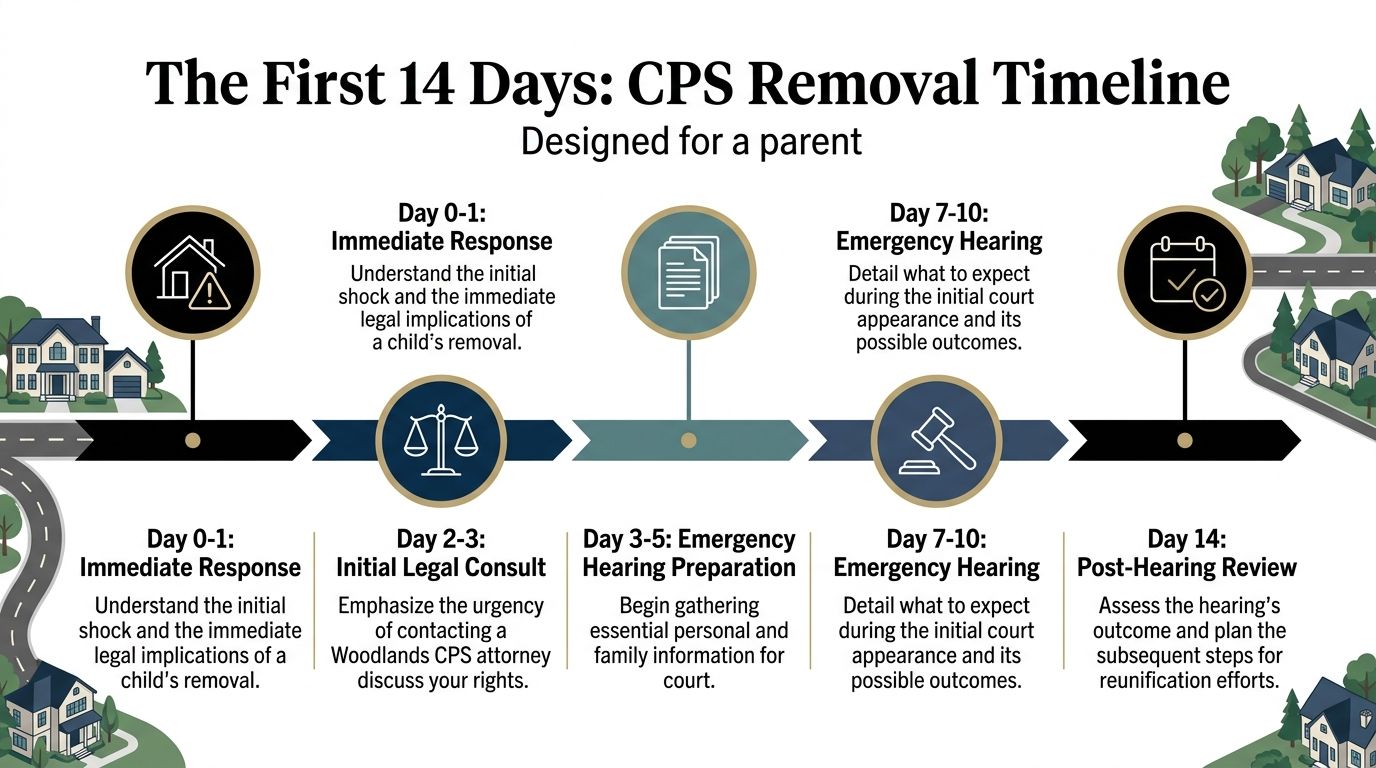
Understanding the First 14 Days After a CPS Removal
Your child is gone. CPS has already told its version of the story. You have days, not weeks, to answer it in court.
In Montgomery County, the first 14 days after a removal are the most important part of the early case because the Adversary Hearing is where the judge decides whether CPS had a legal basis to take your child and keep temporary custody. Parents who treat this like a misunderstanding usually fall behind fast. Parents who treat it like an evidence fight have a real chance to change the outcome.
The deadline matters because the hearing comes quickly after an involuntary removal under Texas Family Code § 262.201, as noted earlier. There may also be a short emergency review right after the removal, sometimes by the next business day. Do not confuse that review with the Adversary Hearing. The emergency review is brief. The Adversary Hearing is the first real test of CPS's case.
What the judge is actually deciding
A Montgomery County judge is not using this hearing to grade your whole life or decide whether you have ever made mistakes as a parent. The judge is deciding a tighter question. Was there immediate danger at the time of removal, was emergency action necessary, and is there a safer option now than keeping your child out of your home?
That local focus matters. In The Woodlands, judges want current facts tied to present safety. Old accusations, vague worries, and character attacks should not carry the day unless CPS can connect them to an immediate risk to the child. Your job in these first 14 days is to break that connection.
Use discipline. If CPS says drug use, answer with testing history, treatment records, prescription proof, and witness testimony. If CPS says unsafe home, answer with photographs, repair receipts, inspection reports, and a clean adult supervisor. If CPS says lack of supervision, answer with school attendance, childcare records, family support, and a clear timeline.
A strong first response usually includes:
- Getting the filed papers immediately. Ask for the petition, supporting affidavit, temporary orders, and any safety plan.
- Pinning down the exact danger CPS claims existed. General labels are useless. You need the specific act, date, and condition they say justified removal.
- Collecting proof that the danger was exaggerated, outdated, or already fixed. Judges care about what was true at removal and what is true now.
- Preparing a safe family alternative. If immediate return is contested, a credible relative placement can block foster care and change the court's view of the case.
- Getting local guidance fast. A parent facing a Montgomery County CPS removal fight needs a county-specific plan, not generic Texas talking points.
What you should control today
Start building your record the same day.
Request every filed document. Write down the exact time of removal, who was present, what CPS said, what law enforcement did, and whether anyone offered a relative placement. Save texts, emails, school notices, medical records, photos of the home, prescription information, and names of witnesses who saw the condition of your child or your home before removal.
Then tighten up your communication. Do not argue with the caseworker by text. Do not post online. Do not assume the other parent, your relatives, or your friends will repeat your story accurately. Loose talk turns into exhibits.
Here is the hard truth. In Montgomery County, early hearings are often decided by which side brings organized proof of present safety. If CPS removed without a court order, the court will look closely at whether there was an immediate danger serious enough to justify emergency action under Chapter 262. If your evidence shows the risk was not immediate, not ongoing, or could have been handled with a less drastic option, you give the judge a reason to limit the removal, place the child with family, or order the child returned under strict conditions.
Your Rights and the Burden of Proof on CPS
The fight at the adversary hearing is usually simple: did CPS have enough proof to take your child without waiting, and is there enough proof to keep your child out now?
In Montgomery County, judges focus hard on immediacy. They want facts showing a present, serious threat to the child, not a messy family history, not vague concern, and not a caseworker's instinct. Under the Texas Law Help CPS timeline materials, CPS must prove four things by a preponderance of the evidence. CPS must show that the child faced immediate danger, that the danger would continue if the child returned home, that CPS made reasonable efforts to avoid removal, and that no less restrictive option would protect the child. If CPS falls short on any one of those points, the judge has a legal basis to return the child or order a safer, narrower alternative.
That is the standard. Hold the hearing to it.
What Montgomery County judges usually want to see
The affidavit and testimony need details. Dates. Names. Conditions in the home. Statements tied to the child. A specific event that explains why waiting for a court order was not safe.
Broad phrases like "unsafe environment" or "parental instability" should put you on alert. Those phrases are not proof by themselves. Your lawyer should force CPS to pin down what happened, when it happened, who saw it, and why a safety plan, a sober relative, or temporary supervision would not have handled the risk.
Here is the framework the court applies:
| CPS claim | What the judge is really asking | What you should challenge |
|---|---|---|
| Immediate danger | Was there a real emergency at the time of removal? | Was the risk current, specific, and supported by actual evidence? |
| Continuing danger | Would the child face that same risk if returned home today? | What has changed since removal, and what protections are now in place? |
| Reasonable efforts | Did CPS try a safer option before removal? | Did CPS contact relatives, discuss a safety plan, or consider supervision? |
| No less intrusive alternative | Was removal truly the last available option? | Could the child have stayed with a grandparent, other parent, or family friend? |
Parents lose ground fast. They argue fairness. The court is deciding proof.
Your rights at the hearing
You have the right to know what CPS is accusing you of. You have the right to see the petition and affidavit. You have the right to be represented by counsel, to question witnesses, to object to weak or misleading testimony, and to present your own evidence.
Use those rights. Do not sit idly by and assume the judge will spot every hole in CPS's case without help.
You also have the right to push back on removals driven by poverty, family conflict, or a rough period that does not amount to immediate danger. A cluttered house is not automatic abuse. An argument with a co-parent is not automatic neglect. A parent getting help for substance issues is not automatic unfitness, especially when treatment and supervision are already in place. If addiction is part of the case, bring records that show testing, treatment attendance, discharge plans, and parenting support. This discussion of addiction treatment and parenting concerns helps explain why treatment should be viewed as a protective step, not a confession that a parent cannot safely care for a child.
If your case overlaps with divorce or custody litigation, be careful. CPS cases often get contaminated by family court allegations. Judges in Montgomery County know that happens, but they still need evidence tied to Chapter 262 standards. A Divorce Lawyer in The Woodlands, TX may already be handling related conservatorship issues, but at this hearing CPS still has to prove immediate danger and the lack of a safer option.
One more point. Start thinking like a trial lawyer, not a scared parent. Bring records that show safe parenting, clean testing, stable housing, medical follow-through, school attendance, and available family support. If you need a practical model for organizing proof, review these types of evidence that matter in Texas child custody cases. The same discipline helps in a CPS removal fight because organized evidence beats emotional explanations every time.
Building Your Defense A Guide to Evidence and Documentation
Your memory is not enough. Your sincerity is not enough. Your binder is what helps.
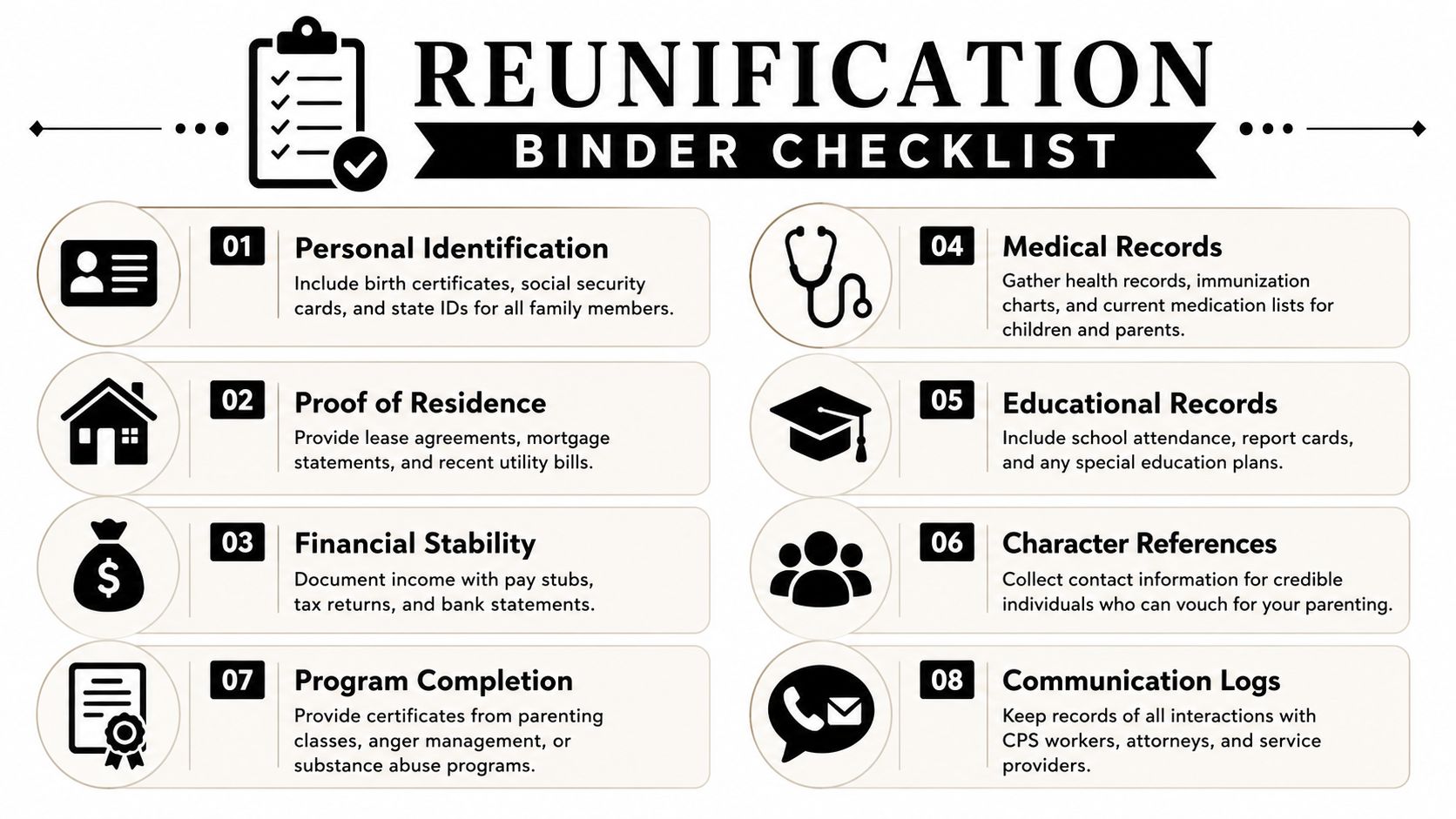
A strong response in a CPS removal hearing in The Woodlands starts with building a reunification binder immediately. According to this discussion of Texas CPS hearing timelines, courts prioritize documented compliance over verbal promises, and cases can be dismissed within the first 6 to 9 months when parents meet requirements or the evidence is insufficient.
Start with one physical binder or one digital folder. If possible, use both.
What goes into the binder
Don't overcomplicate it. Build sections you can hand to a lawyer or use in court prep.
- Court papers first. Petition, affidavit, notices, orders, and any service plan.
- Communication log. Every call, text, email, voicemail, and in-person contact with CPS. Include dates and names.
- Home condition proof. Date-stamped photos and videos of bedrooms, kitchen, bathrooms, food, medicine storage, and sleeping arrangements.
- Child records. School attendance, report cards, immunization records, medical records, daycare records.
- Your stability documents. Lease, mortgage statement, utility bills, pay stubs, work schedule, transportation records.
- Support network. Relatives, teachers, coaches, clergy, neighbors, babysitters, and daycare providers who can speak to your parenting.
- Services and compliance. Any counseling, classes, treatment, evaluations, negative tests, or visitation records.
- Alternative placement information. Names, addresses, and phone numbers for relatives who are safe and available.
If you want a practical companion piece on organizing proof for family court, this page on evidence needed for child custody in Texas fits naturally with CPS preparation too.
A short real-world scenario
A parent in Sterling Ridge gets accused of neglect because the home was "dirty" when CPS arrived. The parent panics and wants to argue about how unfair the report is.
A better move is this: the same day, the parent takes date-stamped photos of each room, the refrigerator, the child's bed, clean clothes, working utilities, and stocked toiletries. The parent then gets a short note from the child's daycare provider confirming the child regularly arrives fed, clean, and picked up on time.
That changes the conversation. Now the parent isn't just denying an allegation. The parent is countering it with organized proof.
Respectful evidence beats emotional outrage every time.
If substance use is part of the allegation
If CPS is raising addiction concerns, don't ignore the issue and don't make excuses. Show concrete action. If treatment is part of stabilizing your case, this resource on addiction treatment and parenting concerns gives useful context for parents trying to address both recovery and child safety responsibly.
Judges respond better to parents who say, "Here is what I am doing, here is proof, and here is how my child is protected," than to parents who insist there is no issue when records and witnesses may say otherwise.
Navigating the Montgomery County Courtroom
The courtroom in Conroe will feel tense. That's normal. Don't let the setting rattle you into talking too much.
Dress neatly. Business casual is fine. Be early. Turn your phone off. Address the judge as Your Honor. Those details won't win the hearing by themselves, but sloppy courtroom behavior distracts from your case.
Who is usually in the room
Most parents expect a private conversation. That's not what this is.
You may see:
- The judge, who decides whether CPS met the legal standard.
- The CPS attorney, who presents the agency's case.
- The caseworker, who may testify about what happened and why removal occurred.
- An attorney ad litem for the child, who represents the child's interests.
- You and your lawyer, if you have one.
Sometimes parents look around the room and assume everyone is on the same side except them. That's not accurate. The judge's job is to evaluate evidence, not rubber-stamp CPS.
How the hearing usually unfolds
CPS generally goes first. The agency presents testimony and documents aimed at justifying removal. Then you get the chance to challenge that presentation.
That challenge usually happens in two ways:
- Cross-examination of CPS witnesses
- Presentation of your own documents, witnesses, and explanations
Your job is to stay factual and child-focused.
Here are better courtroom statements than angry outbursts:
"Your Honor, I understand the concern. I have records that provide context."
"The condition described in the affidavit was corrected immediately, and I have photographs and witness information."
"A relative was available, and CPS did not fully consider that option."
What not to do in front of the judge
Some mistakes hurt parents again and again in Montgomery County courtrooms:
- Arguing with the caseworker directly. Speak to the judge, not across the room.
- Interrupting testimony. Write notes to your lawyer or save the point for your turn.
- Guessing. If you don't know, say you don't know.
- Turning the hearing into a co-parent grievance session. Stay focused on the child and the removal.
- Overpromising. Judges hear promises all day. They trust records, proof, and follow-through.
A calm parent with organized documents often presents far better than a furious parent who insists the system is corrupt. Maybe your frustration is justified. It still won't help if it blinds you to the actual legal test in front of the court.
After the Hearing When to Hire a Woodlands CPS Attorney
You walk out of the Montgomery County courthouse and finally breathe. Do not confuse that moment with safety.
If the judge returned your child, protect that win. Follow every court order exactly. Keep records of every visit, drug test, class, repair, and communication with CPS. Parents lose ground after a good hearing by getting careless, talking too much, or assuming the judge has stopped watching.
If the judge kept your child in CPS custody, the case gets harder fast. The Adversary Hearing decides whether CPS met the immediate danger standard for emergency removal. The next phase is about whether you can show stability, credibility, and follow-through before the court sets the tone for the rest of the case. In Montgomery County, those early impressions matter more than parents expect.
Under the Texas Law Help CPS timeline, a Status Hearing must occur within 60 days after CPS is named temporary conservator, and Permanency Hearings occur within 180 days of removal and then every 120 days after that. Those dates arrive quickly. CPS keeps building its file the whole time. You should be building yours too.

Why hiring counsel after the hearing still matters
The first choice is hiring counsel before the Adversary Hearing. If that did not happen, hire one right after the ruling.
Do not wait for the next setting.
A lawyer's job after the hearing is not just to "be there in court." A good Woodlands CPS lawyer reads the affidavit line by line, compares it to the testimony, identifies what CPS still has not proved, and starts fixing the record before weak allegations harden into accepted facts. That work matters in the first 14 days because parents are still close enough to the removal date to preserve photos, text messages, witness accounts, school records, medical records, and names of relatives CPS ignored.
A lawyer can also tell you what deserves attention first. Not every accusation carries the same weight with local judges. Allegations tied to untreated drug use, unsafe supervision, serious home hazards, or violence in the home usually get immediate attention in Montgomery County. Old relationship drama, vague character attacks, and broad claims that you are "uncooperative" should not control the case unless CPS can tie them to present danger to the child.
What counsel should be doing right away
After the hearing, your lawyer should be pushing on specific pressure points:
- Review the petition, affidavit, and hearing record for weak spots
- Lock down evidence that shows the danger was overstated, corrected, or never immediate
- Press for a safe relative or family friend placement if return is not yet possible
- Prepare you for service plan requirements without letting CPS expand the case beyond the actual allegations
- Stop damaging statements before they become admissions
If you are looking for local help, speak with a Montgomery County CPS attorney who handles removals in The Woodlands courts.
You can represent yourself. That decision carries real risk in a removal case. Early mistakes follow parents for months, sometimes to final trial. One sloppy statement, one missed deadline, or one service-plan misunderstanding can make CPS look more reasonable than it is. In the first 14 days, precision beats emotion every time.
Your Immediate Checklist and Next Steps
If you've read this far, stop scrolling and start organizing. Panic burns time. Structure gives you advantage.
The first 14 days after removal are not for improvising. They are for gathering proof, protecting your words, and forcing CPS to meet its burden under the Texas Family Code.
What to do next
Save this list on your phone and work through it in order.
- Request the petition and affidavit. You need the exact allegations, not rumors about them.
- Start a binder today. Use a notebook, accordion file, Google Drive, or all three. Just don't rely on memory.
- Take date-stamped photos and video. Show the condition of your home as it exists now.
- List every safe relative. Include names, addresses, phone numbers, and how each person knows your child.
- Gather school and medical records. Pull documents that show attendance, appointments, medications, and normal routines.
- Write a communication log. Track every contact with CPS, including missed calls and voicemails.
- Don't sign anything without legal review. A rushed signature can create problems you can't unwind easily.
- Follow court orders exactly. If the judge orders services or visitation rules, comply and document compliance.
- Stay off social media about the case. Screenshots travel fast and age badly.
- Schedule a consultation quickly. Even one focused legal review can help you avoid self-inflicted damage.
The core mindset to keep
You do not need to prove you're a perfect parent. You need to confront the specific legal reason CPS says your child couldn't safely remain at home.
That means your response should be:
- Specific, not emotional
- Documented, not verbal
- Fast, not delayed
- Child-centered, not grievance-centered
This article is for general information only and is not legal advice. Every CPS case in The Woodlands or Montgomery County turns on its own facts, court history, and timing.
If your family is facing a CPS removal hearing in The Woodlands, act like the next court date will shape everything that follows, because it often does.
If you need help sorting out what happened, what the court will look at, and what evidence you should bring together now, you can schedule a consultation with The Law Office of Bryan Fagan. A focused review of the removal papers, timeline, and available proof can help you make better decisions during the most important days of the case.
